
Custom augmented reality trends: where business value is taking shape
Augmented reality has moved beyond the question of whether a digital object can appear on a phone screen. For businesses, the more useful question is whether that object helps someone make a decision, understand a product or complete a task. That shift changes how custom AR projects are planned, measured and maintained.
A retailer may want a customer to compare a product with the space available at home. An event team may want an exhibition visitor to inspect a machine that cannot be transported to the venue. A training provider may want learners to explore the relationship between components before working with physical equipment. Each objective calls for different content and a different measure of success.
The trends below are not predictions that every organisation needs an AR app. They are practical directions to consider when a digital layer can add context to a real-world decision. For South African organisations, the commercial opportunity is strongest when the experience fits the audience's devices, connectivity and operating environment.
From attention to a useful action
Early conversations about AR often centre on novelty: point a camera at something and reveal an animation. That can be an effective way to attract attention, particularly at an event, but attention on its own does not explain whether the experience has achieved a business objective.
A more useful brief identifies the action that follows. A shopper might compare two product configurations. A visitor could explore an enlarged view of a component and then ask for a demonstration. A learner might identify a part and answer a question before moving to a supervised practical exercise. The AR element supports a task that already has meaning to the user.
This approach makes decisions about scope easier. If a product preview needs accurate proportions, invest in reliable dimensions and placement. If an activation needs quick participation, reduce the steps before the first interaction. If a learning experience depends on identifying a part, make that part legible rather than filling the scene with decorative animation.
It also makes measurement more honest. Opening a camera or spending time in an experience is not proof of a sale, learning outcome or operational saving. Those events can be useful indicators, but the project should define the next action and compare results with a relevant baseline where one exists. The business should avoid promising a return before it has tested the proposition.
Product visualisation becomes part of the decision
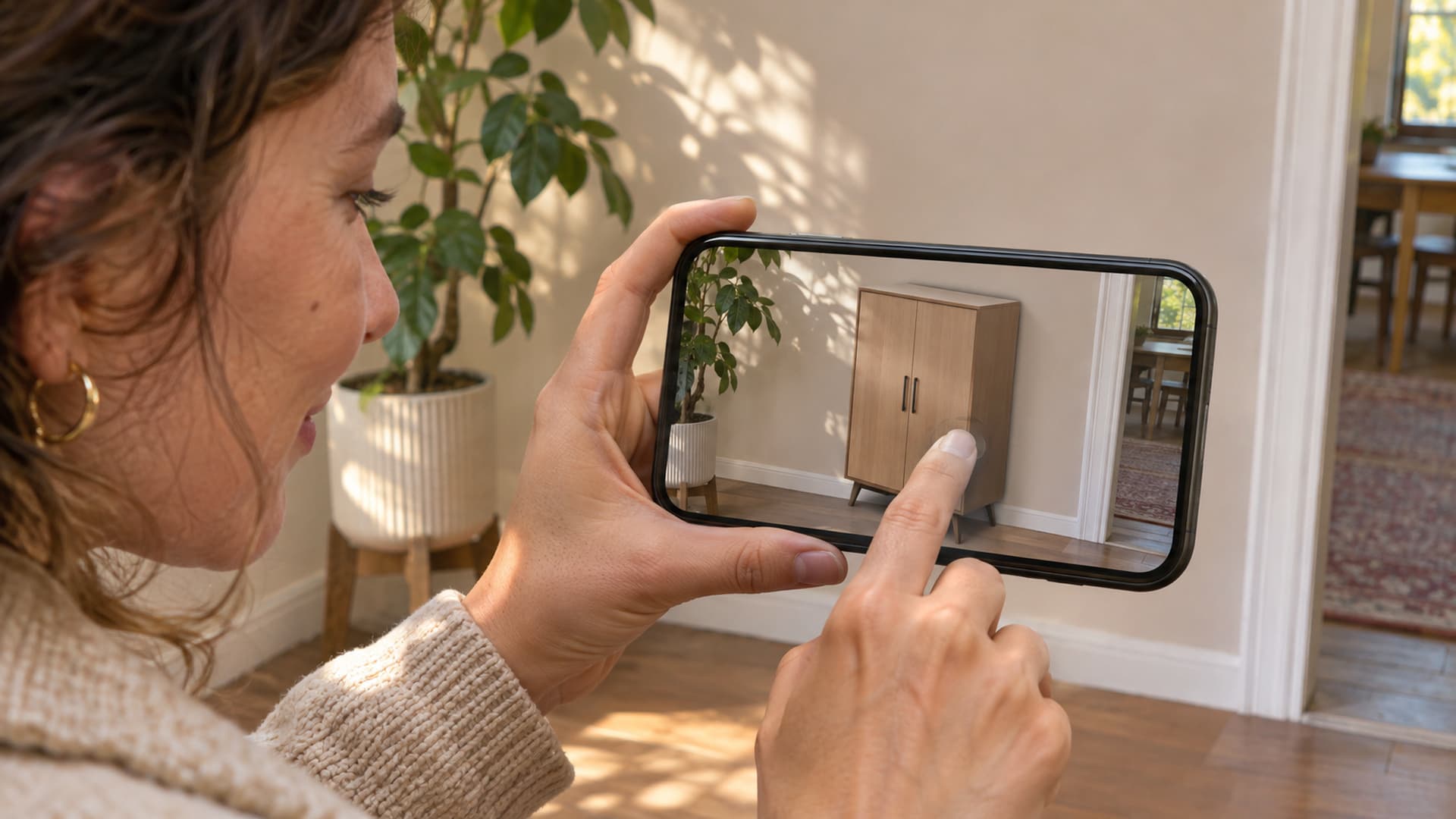
A three-dimensional model becomes more useful when it can be considered in relation to a real setting. A customer can see how a furniture item relates to a room, while a procurement team can inspect the proportions of equipment in a planned workspace. The value is the spatial context, not merely the fact that a model rotates.
The practical challenge is accuracy. A model needs the correct dimensions, orientation and relevant product details. A virtual finish is an approximation on a particular screen under particular lighting, not a guarantee of the appearance of a physical sample. Where fit matters, users should still check measurements and installation requirements.
Apple's AR design guidance discusses why arbitrary scaling may be unhelpful when someone is judging the size of furniture. The wider lesson applies to custom experiences on different platforms: interactions should support the actual decision. Letting a user enlarge an object for inspection may be useful in a training context, while a shopping preview may need to preserve real scale.
A custom build can also connect the visualisation to product options or an enquiry process. The connection must be maintained as the catalogue changes. A model that shows an obsolete configuration can create confusion even if its tracking works beautifully. Define who approves the asset, how variants are updated and what happens when an item is discontinued.
Easier entry points, with trade-offs
A trend in mobile experiences is to bring the interaction closer to the place where interest already exists. Someone browsing a product page can encounter a 3D preview there; a visitor at an exhibition can scan a code beside an object; an employee can open an AR task within an existing application. The route into the experience can be as important as the scene itself.
A browser-led approach can be suitable for a short interaction, but compatibility depends on the device, browser and technology chosen. On iPhone and iPad, Apple describes AR Quick Look, which can present supported 3D content from a link. Android options differ, and a custom journey must be tested on the actual combinations it intends to support.
A dedicated app can make sense for repeated use, signed-in workflows or functionality that a particular web approach does not provide. It introduces its own responsibilities: installation, releases, support and a reason for users to return. A browser link is not automatically cheaper or more capable, and an app is not automatically more engaging. The correct choice depends on the task and the audience.
Plan a useful fallback. A 3D model on a webpage, a video or a conventional product image can still provide value if a camera feature is unavailable. At a public activation, this protects the user journey when a device is unsupported or connectivity is poor. It also gives people a choice about whether to use their camera.
More attention to the physical environment
The most convincing AR content is aware of more than a flat surface. Depth information can help a virtual object appear behind a real object, an effect known as occlusion. Depending on the technology and device, it can also help an application understand aspects of the surrounding geometry.
Google's Depth API guidance explains that support depends on device capability and that the feature must be enabled. Apple's scene reconstruction documentation describes a mesh that estimates the shape of the physical environment on supported configurations. Neither should be interpreted as a promise of a perfect or universally available map.
For a business, the question is whether this additional environmental understanding improves the task. A virtual cabinet appearing behind a real table leg may make a product preview easier to interpret. A model that disappears unexpectedly because of imperfect depth information can have the opposite effect. The team should test both the visual benefit and the failure cases.
Environmental understanding is also not a substitute for a professional measurement or a safety assessment. If a project depends on a precise clearance, establish how that clearance will be measured and verified outside the AR visualisation. A sensible interface communicates uncertainty rather than presenting an estimate as an exact fact.
Location can provide context, but coverage is local
Location-based AR can connect content to a place: a walking route, an outdoor exhibit or a site-specific layer of information. Google describes an approach that combines location information with visual positioning to relate content to the environment through its Geospatial API.
This creates possibilities for tourism, education and public events, but the presence of a global API does not mean a particular South African venue has the required visual positioning coverage or that a device can localise reliably on every visit. Google provides a way to check VPS availability at a location. Teams should test the actual site, access conditions, signal, permissions and the way the environment changes over time.
A location experience also needs a safe user journey. A visitor should not be encouraged to walk while concentrating on a screen in traffic or an unsafe area. A map, conventional signage or non-AR information can provide an alternative when the user is not able to localise. Location and camera data should be handled according to the project's actual privacy arrangements, with a clear explanation to users.
The business value is strongest when the place matters to the story. If the same content would be equally useful anywhere, a location-specific system may add complexity without improving the experience. Ask what the visitor can understand at that location that they could not understand as easily from a webpage.
Reusable 3D assets become a business asset
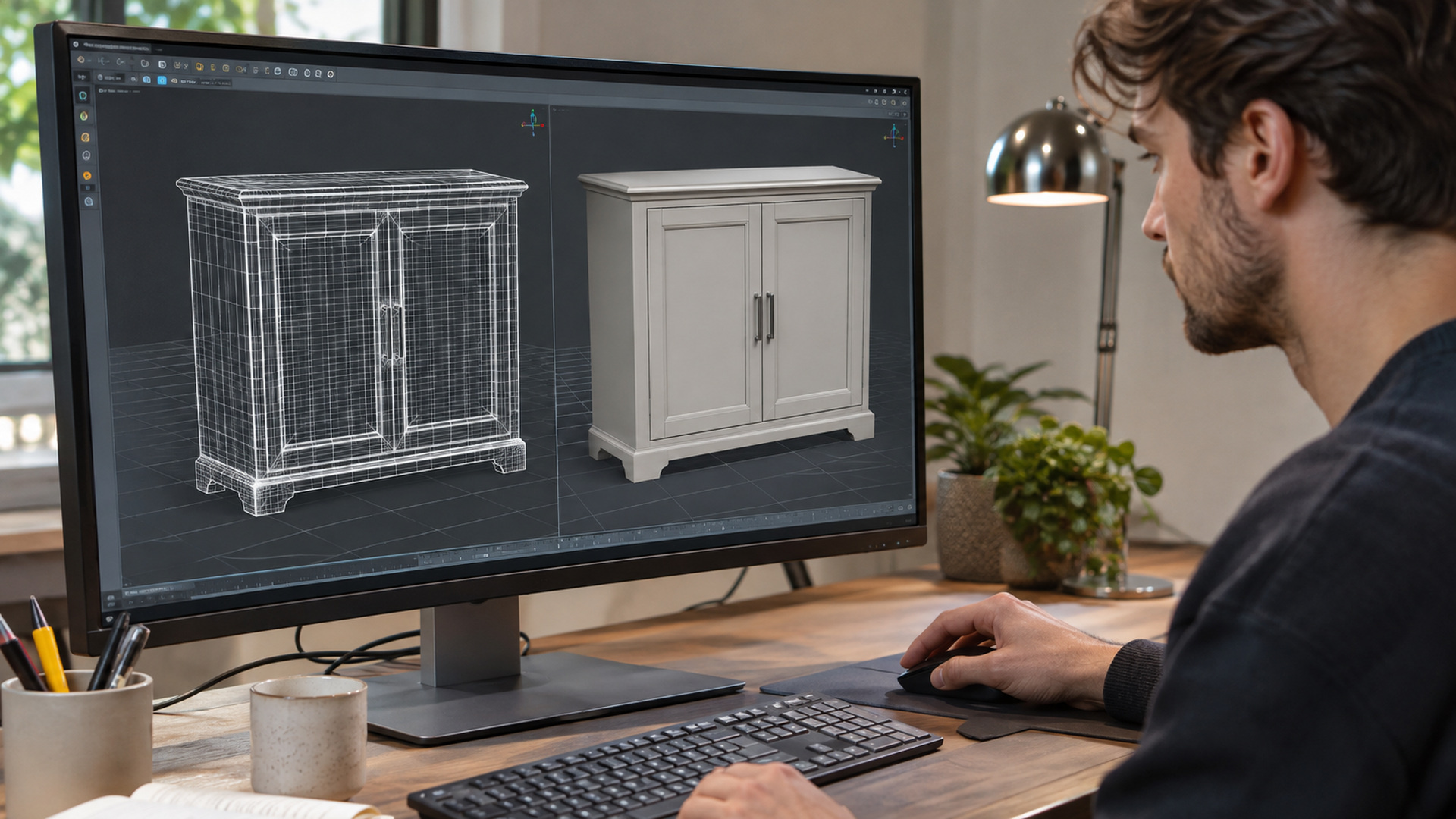
A custom AR project often starts with the visible experience, but the underlying 3D content can outlive a single campaign. A well-organised product model may be adapted for a web viewer, a presentation, training material or another supported AR environment. Reuse is not automatic: formats, file sizes, rights and levels of detail can differ between channels.
The decision to reuse should therefore be part of the brief. Establish who owns the source files, which licences apply to textures or other materials, and whether the business can modify the models. Agree on naming, version control and the process for reviewing a revised model. If a product changes, the team needs to know which experiences use the old version.
There is a balance between building a detailed master asset and producing lighter versions for delivery. A high-resolution model may be valuable for editing but unsuitable for a mobile connection. A mobile version may need simplified geometry and compressed textures. Both should be traceable to approved product information so that speed improvements do not quietly introduce an inaccurate shape or finish.
This makes content governance part of the return on investment. A reusable model can reduce repeated production work over time, but only if the organisation can find it, has permission to use it and knows whether it remains accurate. Those questions are often more consequential than an extra decorative animation.
Analytics are becoming more useful when tied to the journey
Custom AR can provide information about how people move through an experience. Depending on the implementation and consent arrangements, a team may measure an experience opening, a model being placed, a product option being selected or an enquiry being started. The useful metric depends on the purpose of the project.
A retailer should not equate a model placement with a purchase. An event organiser should not treat every scan as a qualified lead. A training provider should not assume that time spent in AR proves a learner can safely perform a task. Connect the events to a broader funnel or assessment and explain the limitations of the data.
Before collecting anything, decide what is necessary, where it goes and how long it will be retained. Camera, location and account information can introduce different privacy considerations from a simple count of anonymous interactions. The technical team and the organisation responsible for the experience should agree on permissions, notices, access controls and applicable obligations.
Measurement should also inform improvements. If many users open a page but few begin AR, the issue may be an unclear instruction or a device limitation. If they start but do not complete the intended action, the model may be slow, the interaction confusing or the next step difficult to find. A small usability test can explain behaviour that a dashboard alone cannot.
Designing for varied devices and connections
South African audiences may encounter an experience on a range of phones, data plans and network conditions. A custom solution should define which devices and operating systems are in scope and how unsupported users will be treated. Google's ARCore device list illustrates why a general label such as Android is not a sufficient compatibility specification.
Asset size and network access are part of the user experience. A detailed model can be compelling, but a long download may cause a visitor to leave before seeing it. For an event, test the venue's network under realistic load and have an operational fallback. For an internal tool, consider managed downloads and whether the task can proceed when connectivity is limited.
Accessibility matters at the same planning stage. Holding up a phone and moving around an object may not be practical for everyone. A conventional 3D view, captions, readable controls and a non-camera route can make important information available to more people. The right alternative depends on the task; it should be evaluated with users rather than treated as an afterthought.
A practical way to assess an opportunity
Before commissioning a custom build, write a short statement of the audience, setting and decision. For example: a visitor at a trade stand needs to understand how a large component fits within a machine and then request a conversation. This statement makes it possible to decide whether AR adds value and which parts of the experience matter most.
Next, identify the evidence needed for a small test. Can visitors start without assistance? Is the component recognisable? Does the interaction help them understand its relationship to the machine? Can the team maintain the content? A prototype can answer these questions before the organisation commits to a larger catalogue or deployment.
Finally, agree what will happen after the initial release. Assign responsibility for content, compatibility testing, support, analytics and privacy. A successful pilot should lead to an informed decision about whether to expand, revise or stop. It should not be treated as proof of outcomes that have not been measured.
Build around a real decision
The direction of custom AR is towards experiences that make digital information useful in a physical context. Better entry points, environmental understanding, reusable assets and measurement can support that goal, but each introduces choices about accuracy, compatibility and maintenance.
The strongest brief begins with a problem worth solving and identifies the people who will use the result. Technology then becomes a means of making that task clearer. To explore a suitable approach for your organisation, see our custom augmented reality service or contact our team.